As spring approaches, many of us will reach for the pruners or contact a tree care company to have our shade trees pruned. Pruning can improve tree health, safety, and longevity by removing dead, diseased, or weak branches, preventing storm damage, and promoting a strong structure. Unfortunately, one long‑standing practice continues to cause significant damage across our landscapes: tree topping.
What is tree topping?
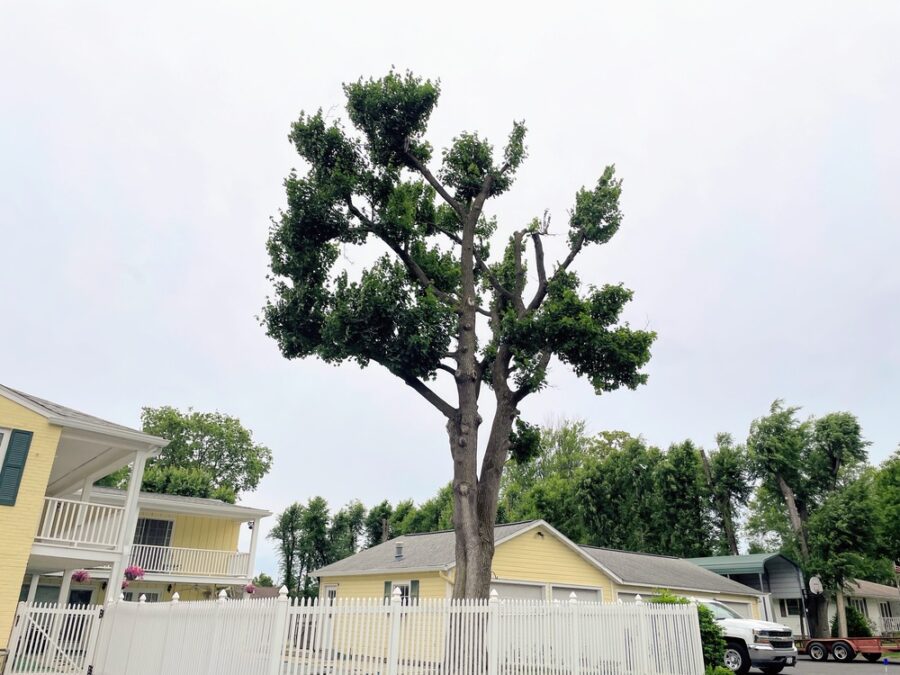
Tree topping, sometimes called stubbing, heading, or hat-racking, involves indiscriminately cutting back a tree’s canopy with little to no regard for natural structure or proper pruning techniques. Topping is commonly done because the owner thinks the tree is getting too big and/or poses a threat, and that topping it will make it safer. However, topping will create a more hazardous tree and will not reduce its height in the long run.
How does topping harm trees?
There are several ways topping damages trees:
- When trees are topped, a majority, if not all, of the tree’s leaf buds are removed, getting rid of the tree’s food-making capability. In response, the tree will need to activate latent buds, which require significant energy, depleting its energy stores.
- The activation of the latent buds will lead to the development of numerous shoots. These epicormic shoots grow rapidly and densely, and within a few years, the tree will reach its original height. Additionally, these shoots are weakly attached, making them prone to breaking.
- The stubs that remain after a tree is topped are slow to seal, if they seal at all. Because of this, there is an increased chance of insect damage and decay pathogens entering the tree.
- When trees are topped, it destroys their natural form. It is replaced with a misshapen, dense, and unsightly canopy. Unsightly topped trees can also reduce property values.
Dealing with a topped tree
In addition to the above-mentioned challenges, topping a tree can be rather costly. While topping a tree may initially be cheaper than removing it, the tree will need ongoing maintenance to remove excessive shoot growth as well as broken or decaying branches, which can pose hazards. Eventually, the tree will need to be removed because a topped tree will decline much more quickly than one that is properly cared for.
What should be done instead of topping?
Before planting a tree, make sure to select the right tree and plant it in the right place. While they may look fine when they are young, consider the mature size of the tree before planting, especially when planting near utilities or buildings.
If a preexisting tree is too large for its location, options include strategically pruning for a crown reduction or removing the tree. If removal is chosen, replant with an appropriately sized species to continue enjoying the benefits trees offer.
In crown reduction, branches are cut back to a large-diameter side or secondary branch that is at least one-third the diameter of the branch being removed. By doing this, no stubs are left behind, and the natural form is maintained. While it may not need to be pruned as frequently as a topped tree, ongoing pruning will be necessary to maintain its smaller size. So, the one-time cost of removal will need to be weighed against ongoing maintenance costs.
A friendly reminder
Anyone can buy a truck and a chainsaw, but there is more to pruning trees than that. When hiring someone to prune trees, make sure they are knowledgeable (a certified arborist is a good place to start). If they offer tree topping as a service, it’s probably best to look elsewhere.
Good Growing Fact of the Week: While they may look similar, topping and pollarding are much different. Pollarding starts when trees are young and involves cutting back sprouts each year to the point where the original cut was made.
***Courtesy of Ken Johnson, University of Illinois Extension, Horticulture Educator***