A physician and artificial intelligence expert is telling health care leaders at Peoria, Illinois-based OSF HealthCare that AI is rapidly reshaping medicine and could dramatically improve early disease detection, patient care and diagnostic speed in the coming years.
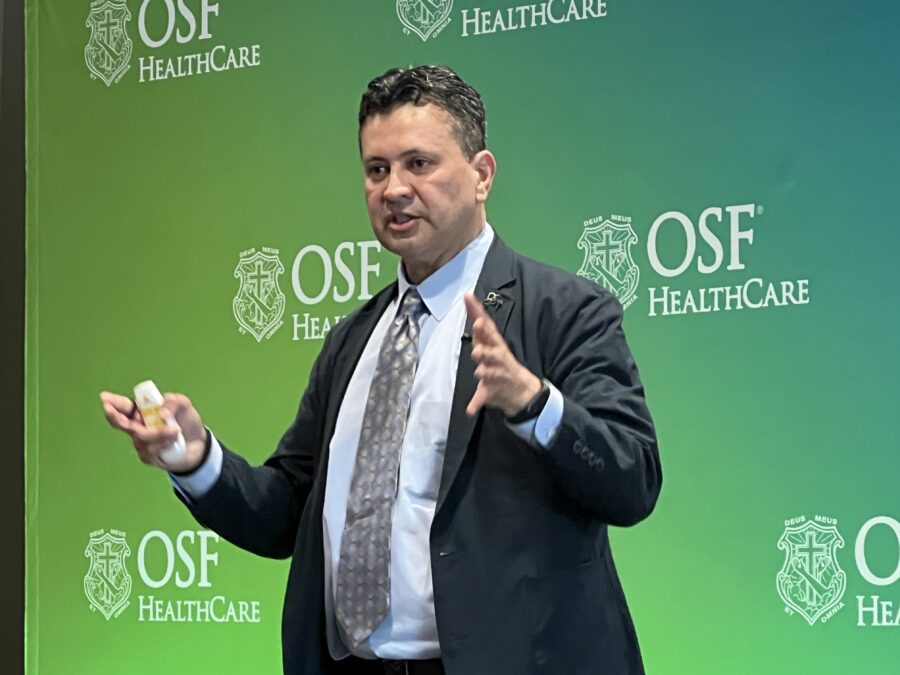
Harvey Castro, MD, known professionally as “Dr. GPT,” highlighted the growing role of artificial intelligence in health care during an OSF Innovation Showcase at Jump Trading Simulation & Education Center, emphasizing its potential to shift medicine from a reactive system to one focused on prevention and predictive care.
During an interview ahead of his presentation, Castro said people don’t come to the emergency department until something’s wrong, but he thinks advances in AI-powered predictive analytics could give health care providers opportunities to intervene before diseases progress.
“Now we’re going to be able to do predictive analytics and know that you’re going to have a heart attack in five years, 10 years from now. Or, like I was saying, this conversation you could say, ‘You know what, the AI is detecting that Dr. Castro has prediabetes and I didn’t know that. And so now the AI is telling me. Now, I’m like wait I need to lose weight, I need to take care of myself, and now I don’t even get diabetes because I’m jumping on it years before the actual condition.”
AI will speed time to diagnosis
Dr. Castro suggests that today’s five-year-old could live to 150 because of the advancements in longevity that artificial intelligence will bring. He also highlighted the technology’s potential in pediatric medicine and rare disease diagnosis, where patients and families often wait months or years for answers. AI systems trained to recognize patterns in symptoms and medical histories could help physicians identify rare conditions faster and begin treatment sooner.
“But what if we could take that year and a half and crunch it down to a day or two, and now we have a diagnosis?” Castro said. “Now as a parent, you know what’s wrong. It’s got to be so frustrating not to know, especially when it comes to your children.”
Among those at the OSF Innovation Showcase were physicians who are treating kids at OSF HealthCare Children’s Hospital of Illinois. His message hit home as Dr. Castro reminded the audience that 50% of rare diseases impact children.
During his remarks, Castro also discussed how health care systems, such as OSF HealthCare, are increasingly building their own AI models using local patient data. He said using region-specific information is critical to ensuring AI tools accurately reflect the populations they serve. He calls that the “gold standard.”
“Let’s say I’m in Texas and I come up here and I say, ‘Here’s my data. Let’s use this AI here,’ it’s not representative of the population here.” Castro stressed, “Right there you can make the argument that it’s going to hallucinate versus yours which is not. I think that’s key.”
Patients are already leveraging AI
For physicians and other providers, Dr. Castro advised that they should leverage AI because patients are already doing it. However, he said patients should not rely on the technology alone for medical advice. Because AI-generated responses can sound authoritative even when inaccurate, he said physicians must remain actively involved in evaluating and confirming information.
“The problem with ChatGPT is it sounds so real and it sounds so correct and it personalizes to you and it knows what words to use so that if it’s making it up, it sounds so real, so the average person won’t know is this hallucinating or is it saying something wrong or is it right? He emphasized, “That’s why I say, especially health care, we need that doctor in the loop.”
Dr. Castro serves on a panel of health care leaders advising OpenAI, which operates ChatGPT, on best practices.
He shared that OpenAI is rolling out a new, optional safety feature for ChatGPT called Trusted Contact. This feature is designed for adult users (18+) and acts as a mental health safety net, allowing users to designate a friend, family member or caregiver to be notified if ChatGPT’s systems detect that the user is engaging in conversations that indicate a serious risk of self-harm.
Despite concerns that artificial intelligence could make health care feel less personal, Castro argued the technology may actually improve patient interactions by reducing administrative burdens on physicians. AI transcription tools, for example, can allow doctors to spend less time typing notes and more time focused on patients.
In looking to the future, Dr. Castro envisions a day when wearables will combine with AI-connected devices in the home that will analyze daily waste, weight and other personal data and send a text to alert someone about a medical concern. In the end, he says artificial intelligence will be better for humanity and allow health systems to better care for people.
***Courtesy of OSF HealthCare***