
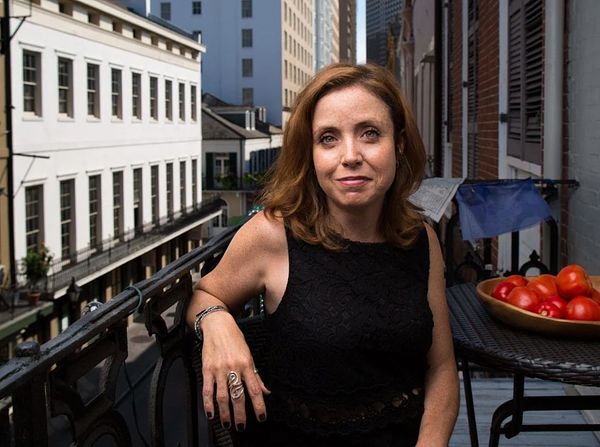
As a Monmouth student, Danielle Nierenberg ’95 wrote about the environment for the Daily Review Atlas. Decades later, that early curiosity has taken her around the world and earned her the Julia Child Award for her work transforming conversations about food, farming and hunger.
During her childhood, activist Danielle Nierenberg relied on books more than television during her leisure time. Still, the 1995 Monmouth College graduate did have a few favorite TV personalities, including one whose name is on the award that Nierenberg was presented in 2020 – the Julia Child Award, which came with a $50,000 grant. The award is presented by the Julia Child Foundation for Gastronomy and the Culinary Arts.
“I remember watching her on PBS,” said Nierenberg, who grew up in the unincorporated Missouri community of Defiance. “We lived out in the boondocks, and PBS was one of the four channels that we got. She was the only woman chef I’d ever seen. Watching her really set the stage for me.”
As did one of the books that a young Nierenberg read that began her trajectory to the Julia Child Award, which is presented annually to a person who has made a profound and significant difference in the way America cooks, eats and drinks.
At the age of 13, Nierenberg read Diet for a Small Planet, a 1971 bestselling book by Frances Moore Lappé. It was the first major book to note the environmental impact of meat production.
“Her work really inspired me, and it influenced what I tried to write about in the newspaper,” said Nierenberg, referring to the weekly “On the Environment” column she wrote for the Daily Review Atlas as a Monmouth student. “I know her personally now – we’re friends.”
From Monmouth, Nierenberg went to Boston, where she completed her master’s degree in agriculture, food and environment at the School of Nutrition Science and Policy at Tufts University.
Child was living in Boston at the time, which influenced Nierenberg’s choice of part-time employment.
“I took a job at a pizza place, partly because she was known to order from there,” said Nierenberg. “It never happened while I was there, but the chance that it could made going into work more exciting.”
Nourishing the planet
In the decades since, Nierenberg has become a leading journalist, author and activist on food-related issues such as the spread of factory farming in the developing world and innovations in sustainable agriculture.
In 2009, she co-founded the Nourishing the Planet project housed at the Worldwatch Institute and became its director. As part of that role, she spent 18 months in sub-Saharan Africa, looking for solutions to poverty and hunger in 30 countries.
In 2013, she was a co-founder of Food Tank: The Think Tank for Food. The organization aims to offer solutions and environmentally sustainable ways of alleviating hunger, obesity and poverty by creating a network of connections and information.
“We try to do things like teach children where food comes from,” said Nierenberg. “We work toward getting people to change the way they grow, harvest, eat and dispose of food. And we try to highlight folks who have often been under-represented like farmers, grocers, truck drivers. They are essential frontline workers, much like healthcare workers are.”
Nierenberg is known for conducting extensive on-the-ground research, traveling to more than 70 countries across sub-Saharan Africa, Asia, Eastern Europe and Latin America. She’s met with thousands of farmers and farmers’ groups, scientists and researchers, policymakers and government leaders, students and academics, and journalists, documenting what is working to help alleviate hunger and poverty while protecting the environment.
She speaks at more than 100 events per year, including major conferences and events all over the world, including SXSW, TED, the Chicago Council Global Food Security Symposium, the Sustainable Food Summit and the Bill & Melinda Gates Foundation, just to name a few.
She has built a worldwide social media and web following of more than 1,500,000 including 350,000 weekly newsletter subscribers from 190 countries; 360,000 combined Facebook fans; and 600,000 combined X (formerly Twitter) followers, 80,000 combined on LinkedIn, and 59,000 on Instagram.
Nierenberg used part of the $50,000 grant money from the Julia Child Award for a Food Talk Live event at the Smithsonian Institute on World Food Day. The events Nierenberg helps organize are known for “bringing together people who aren’t likely to be in the same room – food advocates and company executives, people from different sides of the aisle,” she said.
Speaking about those events in a Washington Post article about her award, Nierenberg said: “If you had asked me 15 years ago, would I be talking to these companies, I would have said, ‘Heck no, they’re part of the problem.’ But now I understand. If we’re not talking to the people we disagree with, the food system will always be broken.”
The Julia Child Award has also increased Nierenberg’s visibility, including an appearance on the Inside Julia’s Kitchen podcast, for which she prepared a meal that was shown on Instagram Live. She chose a vegetarian version of a Julia Child staple – beef bourguignon.
“My husband eats meat,” said Nierenberg. “He’d have steak every day if he could. But he told me my dish was the most delicious thing he’s ever eaten.”
Nierenberg, who lives in Baltimore, was informed of her award several months prior and could only tell her mother and husband about it.
“I was shocked, floored. I cried, just burst into tears,” she said of the honor, which has typically been presented to leading American chefs. “I never thought I’d be associated with Julia Child and other chefs. They made a real switch (that) year.”
Nierenberg also became emotional when thinking about Monmouth faculty member Ira Smolensky, who helped her set the direction of her future.
“I really wish Ira could have seen me win this award,” said Nierenberg of the late political science professor, who was one of her mentors. “I wouldn’t have been able to achieve what I’ve achieved without Ira. He would be really proud of this.”
***Courtesy of Barry McNamara, Monmouth College***