
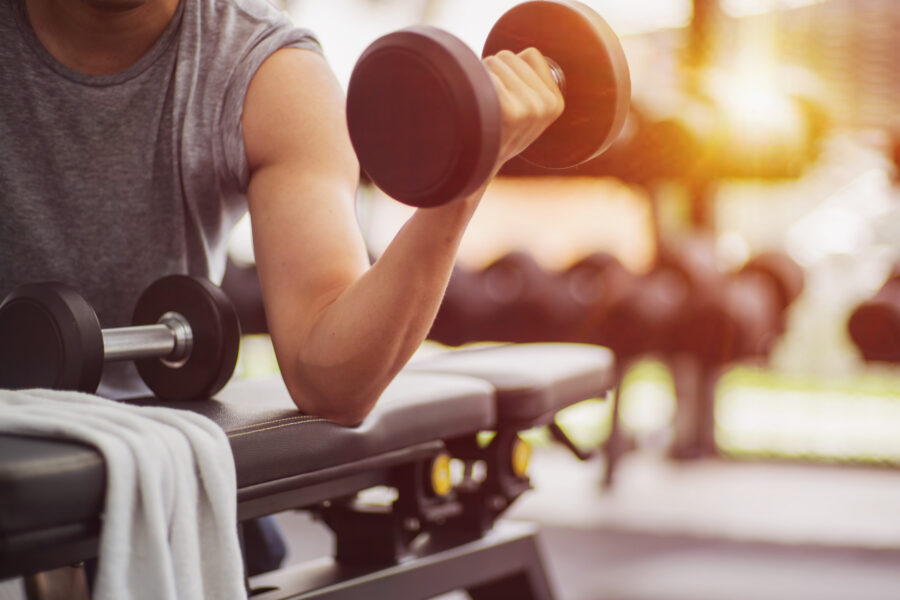
August means high school and college athletes will be back in the weight room full time, building strength so they can excel on the field.
But for Brittany Delaney, an OSF HealthCare athletic trainer who works with high school athletes, keeping people safe in gyms and weight rooms is on her mind year-round.
“I see a lot of back and neck pain” from weight room injuries, she says. “I see muscle strains – hamstrings, quads, lats, pectorals. These kids don’t necessarily know the proper weight to start at.”
Tips to know
- Have good posture and body mechanics. Delaney says to have a wide base when lifting heavy weights, and lift with your legs and core, not your back. Bend your knees while keeping them straight, and bring your rear end down, she says.
“Avoid twisting motions at the torso,” Delaney adds. “Try to overexaggerate movements. When you’re doing a rotational exercise, move your feet, not just the torso.”
- Keep the weight close to your body.
- There’s no glory in trying to impress the room with a heavy lift, then injuring yourself. Instead, Delaney says to start with a light weight (talk to your coach or trainer on the exact number) and more repetitions, rather than a heavy weight and less repetitions.
“That way, we can work on mastering their form first. Make sure they’re doing it properly to avoid injuries,” Delaney says.
Delaney tells her athletes to try three sets of 10 repetitions. If you don’t feel pain or fatigue, you can try increasing the weight. For the upper body, go up by two and a half to five pounds. For the lower body, increase by five to 10 pounds.
- Do you need a spotter for every lift? Delaney recommends having a buddy watch you if you’re lifting a heavy weight or you’re in a position to drop the weight on yourself, such as a bench press.
“That would be a major injury if you’re bench pressing and drop a weight on your chest,” Delaney warns.
- Know how to use the equipment before strapping in.
- Keep your surroundings clean and clear. When you’re done with an exercise, clean the equipment and put the weights away. When you’re resting, move away from others. Otherwise, athletes could run into each other. When cleaning, use a wet wipe or spray. If using a spray, spray the solution onto a cloth first, not directly onto the equipment. Delaney says unclean equipment can lead to transfer of germs that cause skin rashes and more ailments.
- Dress for success, not to impress. Delaney chuckles when asked about people going to the gym in blue jeans, sweaters or Crocs. All bad ideas, she says.
“You want to be in something breathable because you’re going to be sweating,” Delaney says. “You’ll see people at the gym working out in sweatshirts. It’s super hot in the gym, and they want to sweat more. That’s not advised because you can increase your chance of heat illness. And those types of clothes don’t allow for full range of motion. If you can’t fully go through the range of motion, are you truly strengthening that muscle? Not as much.”
A good pair of tennis shoes are a must for everyone. For men, Delaney says shorts and a t-shirt work. For women, leggings are OK too. Not too tight and not too loose are the keys, Delaney says.
What about listening to music to get in the zone? If you’re by yourself, that’s fine. But if you’re in a group, Delaney recommends keeping your ears free of headphones so you can be aware of your surroundings. Not to mention that weightlifting is a camaraderie building exercise, too. No headphones mean you can cheer on your teammates.
- Know when to stop. If you have pain, numbness, tingling or range of motion issues (such as not being able to move your neck), talk to the adult in the room.
- Know the signs of cardiac arrest and where the nearest automated external defibrillator (AED) is. Delaney says every athletic facility these days should have an AED, and she says they’re easy to use by just following the device’s prompts. Someone else should be calling 9-1-1 while this is happening.
Delaney says signs of cardiac arrest include shortness of breath, lightheadedness or dizziness, nausea, heart palpitations or a racing heartbeat chest tightness and loss of pulse.
The bottom line: Communication is key
“Communicate with your teammates and coaches,” Delaney implores. “It’s always OK to not know how to do an exercise and ask for help. In no situation should you be made fun of or be nervous about asking for help. Not doing so is when you’re going to get hurt.”