
Summer institute was made possible by grant from National Endowment for the Humanities
by Barry McNamara
Classics is having a moment. Over the weekend, The Odyssey cashed in at the global box office, smashing expectations by grossing $264.1 million.
Call Monmouth College’s summer institute on the ancient Olympics a prequel to that success. The two-week National Endowment for the Humanities program – which is officially titled “The Ancient Olympics and Daily Life in Ancient Olympia: A Hands-On History” – concluded the same day as the movie’s opening night. In fact, a road trip to Galesburg to watch Christopher Nolan’s epic action film was the final activity for the institute that brought K-12 educators from across the United States (and beyond) to Monmouth’s campus.
Despite some “corny” dialogue, Monmouth classics professor Bob Simmons said he and the institute’s participants “generally liked it. We thought the movie tied in many elements of the original epic in creative ways, and we were greatly impressed by the visuals.”
Getting out into the community was a theme of this year’s institute, with Nathalie Roy citing that dynamic as one of the differences from when she and Simmons oversaw the first version of the institute in 2024.
“One night, we went out to that bar by Kirkwood that’s surrounded by cornfields,” said Roy, an award-winning middle school classics teacher in Baton Rouge, Louisiana, referring to GT’s Bar. “They were all talking to the locals. They had the best time. Everyone we encountered in the community was so pleasant and polite. The mayor came to talk with us one day – we were so impressed. A lot of these institutes are in big cities like Pittsburgh or New York, but it was neat that we still had so many opportunities to interact in a smaller community.”
“Monmouth and the area provided a wealth of interesting opportunities for our visitors,” added Simmons, who also mentioned the evening at GT’s as a highlight, in addition to a farmers’ market and trips to the Warren County History Museum and the Stoneware Museum.
‘Fun and educational’
Those community extras were just one reason why a review of “generally liked it” falls short of how the 23 participants felt about the institute. They came to Monmouth from Vermont to California, from Idaho to Florida, and even from Brazil, representing 21 states in all.
The Vermonter – high school and middle school Latin teacher Sarah Allen – called the institute “fun and educational. I’m going to take so much of what I did here and bring it home with me. There were some amazing experiential learning ideas.”
In a nutshell, that’s the goal of the institute, explained Simmons.
“There were lots of comments about the power of learning in a hands-on, immersive style,” he said. “Our hope is for them to implement that style in their classrooms across age groups and across the curriculum.”
“Many of our participants had never thought of the physical aspect of the ancient Olympics and ancient life,” said Roy. “There are things we don’t consider when we simply read about something – what I call the smellscape, the soundscape. This institute helped them experience it on a deeper level.”
New this year was a consultant on ancient animal sacrifice – Carleton College classics professor Jake Morton, who Roy said “was a butcher in a previous life. He’s taken that knowledge and introduced a new element to the institute.”
Micheal Posey, a K-12 liaison at Mountain Brook Schools in Alabama, attended the 2024 institute and this time around was part of its five-person staff.
“I felt like we did a good job of working out the kinks. It had a Goldilocks feel this time – we got things just right,” said Posey, who said he first got into studying the ancient world years ago as “my way to escape Alabama.”
“We also learned about the millennia-long, cross-cultural history of cheese and how to make it in ancient style,” said Simmons. “Techniques and tools for making small batches have changed very little over time. Other than those additions, things went so well last time that we didn’t want to mess too much with the formula.”
Demigods and heroes
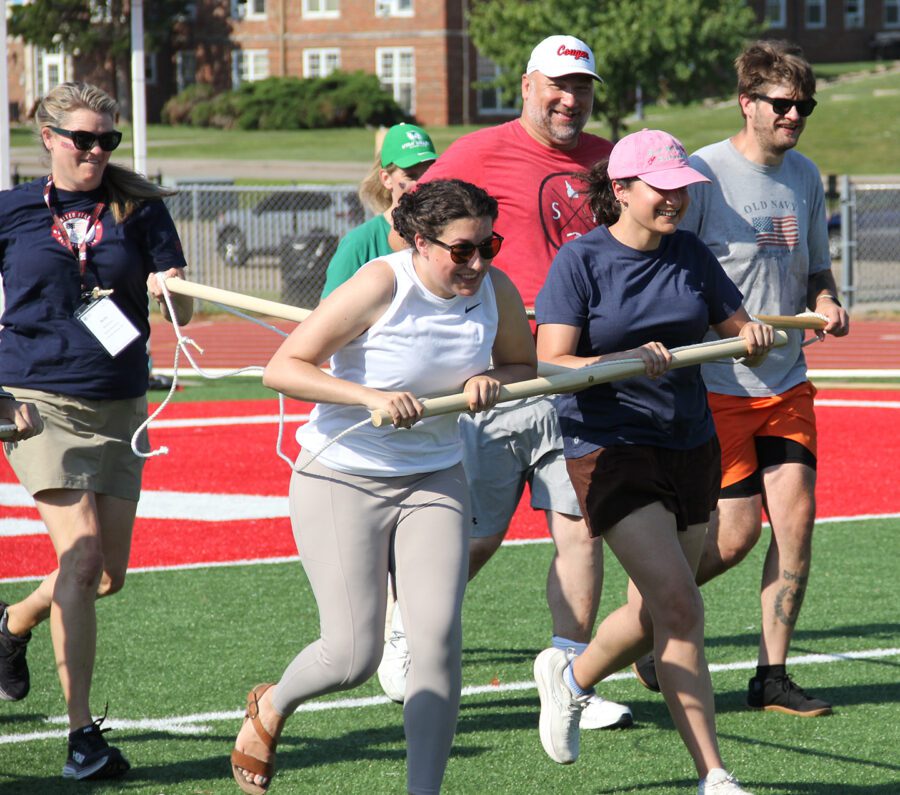
That included staging another mini-version of the Olympics on the penultimate day of the institute, this time held on the turf of April Zorn Memorial Stadium. Umbrellas were needed, but they were used to ward off the bright sunshine, rather than rain drops.
“We’re recreating this in authentic atmospheric conditions,” said Simmons of the sultry morning during his opening remarks. “So we’ve got that going for us.”
Not present were the 40,000 spectators who cheered on the Olympians 2,500 years ago, nor was Milo of Croton, who Simmons called the “greatest wrestler in human history.” Milo’s training regimen was said to include lifting a newborn calf every day until it grew into a full-sized bull.
But present were three-person chariot races, javelin and discus events, and a long jump contested while holding weights. Institute winners didn’t receive an olive wreath, as the ancient Olympians did, but they did earn the same type of red ribbon from centuries ago, which a few then proudly displayed as headgear.
“We’re very grateful to the National Endowment for the Humanities for their grant,” said Roy. “We were one of only seven chosen. It’s a great testament to the importance of classics. And we’re also grateful to the team at Monmouth. It’s like they adopt us.”