
Barry McNamara | Published September 30, 2026
For the past several years, Monmouth College’s educational studies department has placed a strong emphasis on rural teachers – both the nationwide need to develop them and providing the specific skills students need to get them ready for success in that niche.
It’s only fitting then that the National Rural Teacher of the Year – selected by the National Rural Education Association – is a Monmouth College graduate.
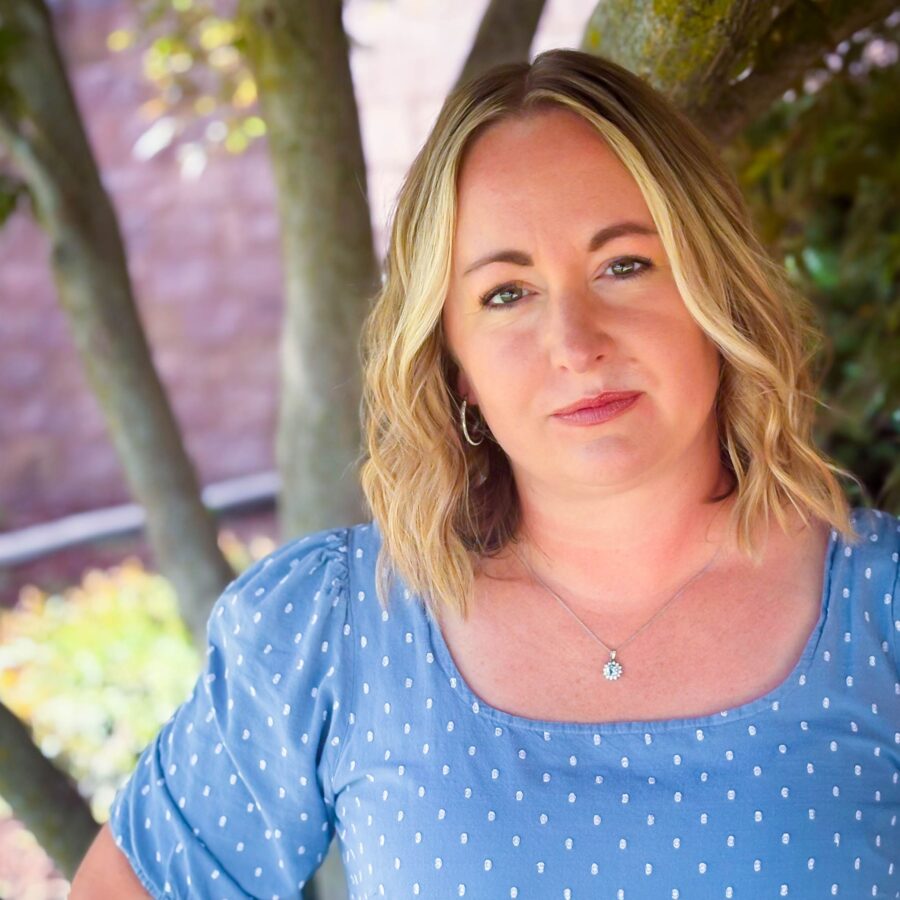
Jennifer Drendel Burdette ’08, who teaches social studies at Spoon River Valley High School outside of London Mills, Illinois, is the most recent recipient of the annual honor after earlier being named the Illinois Rural Teacher of the Year. Each year, the NREA Foundation interviews candidates across the nation to make its decision, focusing on the stories that have the greatest impact on rural communities.
“I strive to serve as a model for my students in both character and leadership while also showing them what it looks like to dream big and work to achieve those goals,” wrote Burdette in her nomination materials. “I want all of my students to understand that geography does not have to be limiting and people in small communities do have a national impact.”
State affiliate organizations are encouraged to submit their own state winners for consideration in the national award program. The Association of Illinois Rural and Small Schools launched its Illinois Rural Teacher of the Year program just last year, making Burdette only the second teacher to win that award.
The Illinois selections committee noted that it was particularly moved by Burdette’s “efforts to educate and mentor above and beyond her regular duties as a teacher,“ as well as her work to “advance the importance of civics, civic-mindedness and democracy.”
Burdette will be presented with the national award in October at the 2026 National Forum to Advance Rural Education in San Antonio, Texas. She will also give a keynote address about her education story, representing her school and her state in front of hundreds of rural advocates. She will then be celebrated and highlighted throughout the next year.
Her Monmouth story
Burdette credited her training at Monmouth for helping her develop into a talented and caring teacher – a role she’d long envisioned her herself.
“I’m one of the lucky few who always seemed to know what they wanted to do,” said Burdette, who grew up in Hampshire, Illinois, halfway between Chicago and Rockford. “Even as a kid, I was drawn to teaching – playing school or helping my mom as a volunteer school librarian. We took a field trip to Colonial Williamsburg in junior high. From that point on I was pretty much in love with history and determined to be a history teacher.”
She knew her future profession, and she was equally sure about where she’d study, or so she thought.
“For my whole life leading up to senior year, I swore that I wanted to attend Northern Illinois University and stay local,” she said. “Then senior year came and I visited and realized that it just wasn’t for me.”
Burdette began looking at smaller schools, and a dream-like visit to Monmouth sealed the deal.
“I’ll always remember that on my first visit, I’d fallen asleep on the drive into Monmouth,” she said. “I remember waking up as we arrived and just having this overwhelming feeling of home. I think the tree-lined streets just felt familiar and the campus was so beautiful.”
Best memories
A few months later, Burdette was taking history classes from professors such as Stacy and Simon Cordery, Bill Urban and David Suda, as well as former junior high history teacher Tom Best.
“I remember Tom’s ‘Social Studies Methods’ class, and I’ve been lucky enough to work with him in my professional life, too,” said Burdette. “His love of history and teaching and desire to learn has always been an inspiration to me.”
Burdette also appreciated Urban’s stories from being a world traveler and Suda’s 19th century arts and letters course, even though, as a freshman, “I felt like I wasn’t smart enough to be there.”
Other professors had an impact, too, including Mark Willhardt – “he was personable in a way that made you feel seen and valued” – and Monie Hayes, who “cared deeply about what she taught, but she also taught me to give students grace.”
“All of those professors challenged me to broaden my thinking about the world, but they also took the time to get to know me as a student,” said Burdette. “They encouraged me to take on new experiences and helped lead some of those experiences through organizations like Phi Alpha Theta and History Club. Maybe most importantly, they saw something in me and spent time mentoring me so I left Monmouth feeling confident to take on professional life.”
Burdette recalled one of those new experiences, in particular, with Stacy Cordery.
“My senior year, I asked to be a teaching assistant for Dr. Cordery, as she was conducting her book tour (for her biography on Alice Roosevelt Longworth). That gave me my first experience really leading a classroom, and it challenged me in ways I hadn’t expected. Although I maybe wasn’t fully ready to step into that position, I appreciated Dr. Cordery entrusting it to me.”
Burdette said she also enjoyed the non-classroom side of college, including playing croquet in Urban’s backyard as part of Phi Alpha Theta, sledding down Wallace Hall’s hill, the sound of bagpipes being played, attending the Chicago Humanities Festival her senior year, and finding a cubicle to work in at Hewes Library. It all led up to her receiving the Garvin Davenport Prize in history her senior year.
Relationships are central to teaching
As is typically the case with Monmouth’s style of a liberal arts education, Burdette was shaped by much more than textbook learning and lectures.
“I think a lot of what I learned came not always from the content itself but from my interactions with my professors and how they treated us,” she said. “Those experiences stuck with me as much as anything and shaped how I wanted to be as a teacher and the relationships I desired to build.”
Burdette was asked to provide some advice to Monmouth students hoping to follow her career path, and since she’s the National Rural Teacher of the Year, that advice carries a little extra weight.
“Say yes to any opportunity that comes your way and step outside of your comfort zone,” she said. “The most worthwhile experiences I’ve had in my teaching career have been the ones that I was most hesitant to undertake, but pushing myself out of my comfort zone has allowed me to continue growing as an educator. Likewise, never stop seeing yourself as a student. There is always something new to learn.”
With nearly 20 years of experience in the field, Burdette has been tested often, and she said that’s OK.
“Ultimately, teaching is a very rewarding profession, but it comes with its challenges, and you have to have perseverance and resilience to make it through those moments,” she said. “Additionally, you have to have the ability to find the positive in people and to care about your students.”